Integrated Design Project

20. 03. 2014
3 minuty čtení
Some people say it is a nightmare full of late night stays in the department, others acknowledging the workload claim they had enjoyed it. I have been through this as well and I must say it was time demanding, but also very rewarding and enjoyable.
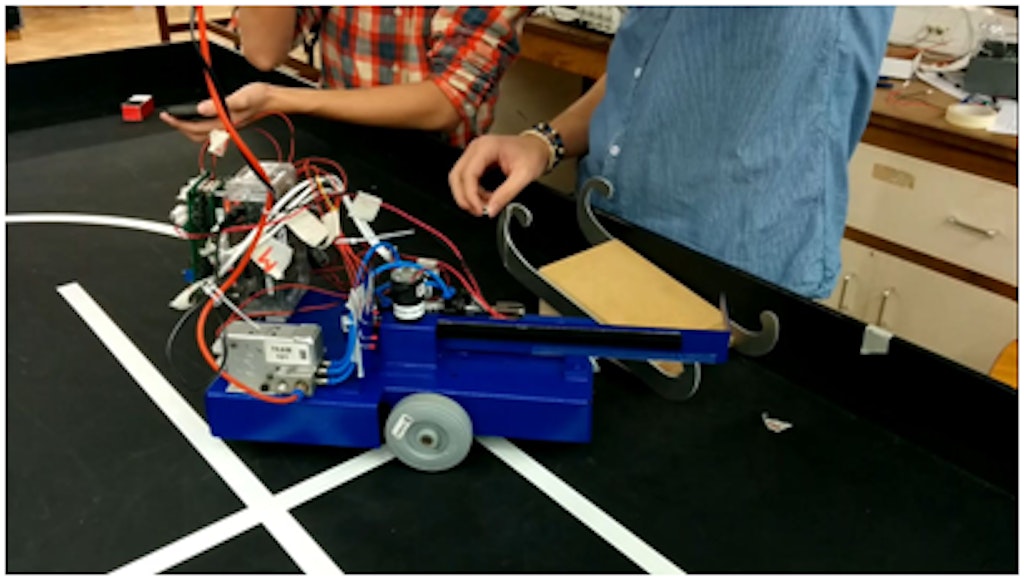
Our robot at a drop-off point
IDP is a four week long project during the term time. Because there is around 250 students in our year, only around sixty students undergo this project at a time. This student cohort is split into groups of 6. Within each group, students decide which area they want to work on: mechanical, electrical or software. The aim of the project is to build an automated vehicle that performs certain tasks. At the end of the four weeks, there is a competition.
Our cohort had to design a robot that would collect two parcels at a time from a moving conveyor belt and deliver them to appropriate sledges. The parcels were 6x3x2cm boxes with a barcode. They differed in colour — green, red, blue —, weight — 14g, 10g, and 4g respectively — and some of them had little magnets inside. There were white lines on a black background for the robot to follow.
Our team has decided to use strain gauges for parcel identification. The reasoning was that strain gauges¹ would need to be calibrated only once as the weight of the boxes does not change as oppose to using a colour sensor, whose reading can be influenced by the ambient lighting conditions. We could not have been more wrong. Strain gauges turned out to be an utter nightmare. It was merely impossible to build such a sensitive circuit, as we needed to detect a 4 g difference. The noise in the circuit was comparable to the change in our measurements. At one stage, we managed to make a flow sensor by accident, as readings were changing depending on how hard you were blowing on the circuit. In the end, we managed to build it employing a £4 op-amp (the gain of single stage amplification was 55 000) but it had to be calibrated often. Given how sensitive our circuit was, it had to be calibrated using a big oscilloscope so I felt like a doctor during calibration.
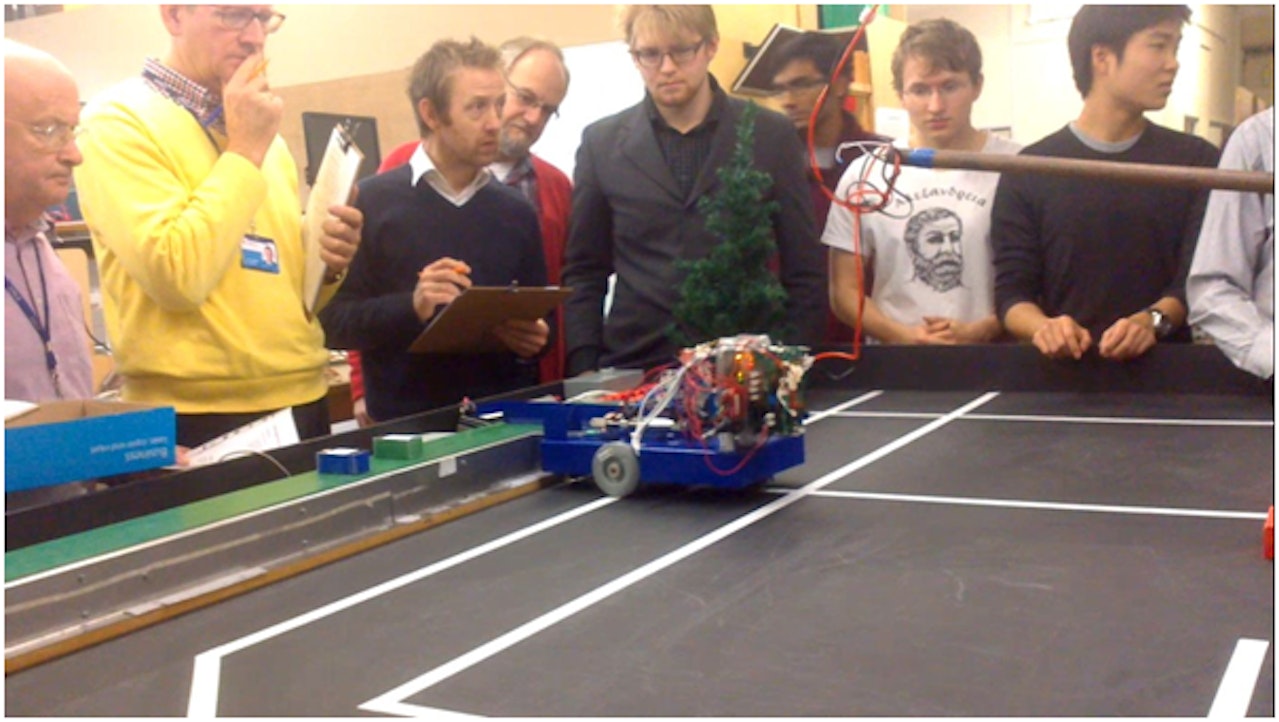
Our robot collecting parcels
A day before competition, our robot seemed to be doing OK. It travelled around the field, collecting parcels, identifying them and dropping them off. If the competition was on that day, we would have scored 136 points. Unfortunately, our robot was not robust and reliable, so we scored only 36 points during the competition. However, it was still good enough to put us on a fourth place out of 12 teams.
IDP was a truly great experience. It demonstrated the importance of reliability, robustness and tolerance for engineering products. It would have been more enjoyable had we had more time. Having done no circuit building before, I really enjoyed being in an electrical sub-team, especially the strain gauges challenge. It was also nice to see applying what we learned from lectures.
Recommended reading:
IDP website: http://www3.eng.cam.ac.uk/DesignOffice/idp/resources/index.html
For more photos http://www3.eng.cam.ac.uk/DesignOffice/idp/idp_photos/index.html
________________________________________________
¹Strain gauge is a device that measures strain. It works on a following principle. An object placed on a cantilever will cause it to deflect. That means that upper surface of the cantilever gets slightly longer and the lower surface slightly shorter. If you attached a wire on the upper surface, the wire would elongate with the surface. As the wire is now longer, it has got greater electrical resistance, which is something that can be measured easily. For more information: http://en.wikipedia.org/wiki/Strain_gauge.







2026 © THE KELLNER FAMILY FOUNDATION